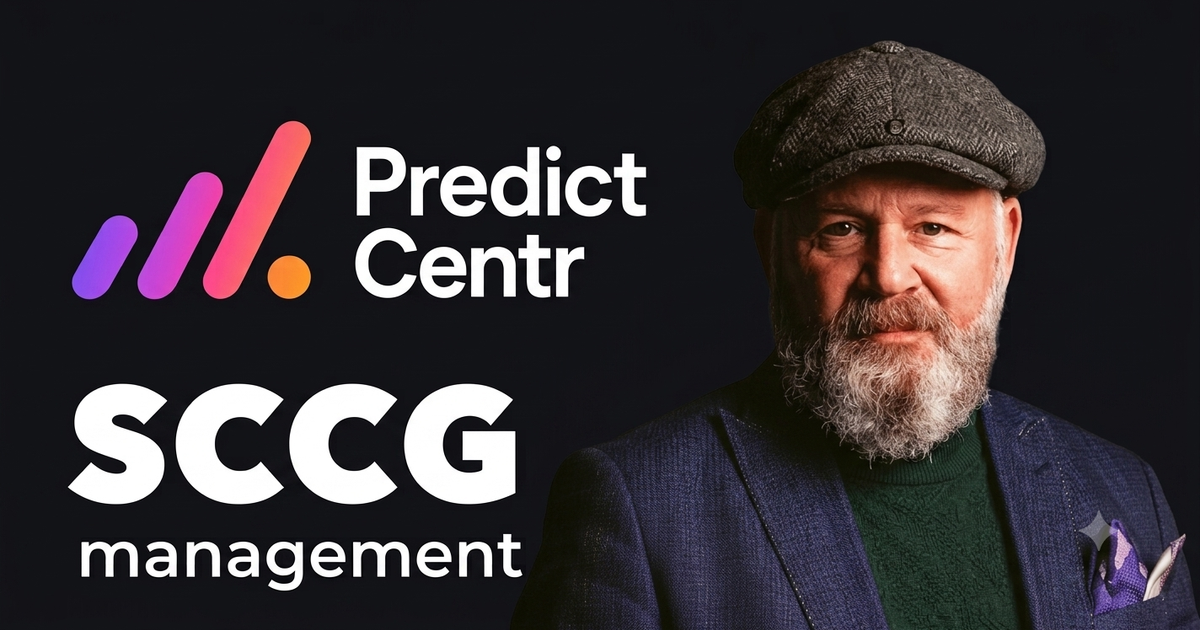


Next.io, which defines itself as "the world's iGaming community," has spent the last 19 years in the gambling events and media space. It is one of the world's leading conference organizers in the digital entertainment industries, and has built that reputation on the back of events such as Malta's NEXT Summit Valletta and Next Retreats in Europe and Latin America.
Its Co-Founder, Pierre Lindh, has quite a story of his own. He has spent more than 20 years in the iGaming space, and even lobbied for poker's legalization in his native Sweden in the 2000s. It was in 2007 that he co-founded NEXT.io alongside Martin Pettersson and Michael Pedersen.
Lindh's latest venture is NEXTPredict, which as its name suggests, is an independent news source focused on a hot topic in the industry, prediction markets. The event bearing the name of that brand, NEXTPredict NYC, will take place from October 22-23 this year, with 2,500 delegates expected to converge at the Convene at Hudson Yards.
As that exciting summit approaches, PredictCentr caught up with Lindh to get some insight into the event, billed as "the world's first large-scale, dedicated prediction markets summit." Interestingly, he explained why he is hedging his own summit with a $12,000 position on Kalshi.
NEXTPredict is a new brand, having only launched earlier this year. What did you see happening in prediction markets that convinced you the industry was ready for its own dedicated media platform and B2B event?
We started NEXTPredict because the same thing became obvious to us twice, and almost nobody in our part of the world was talking about it.
The first was a framing thing. In Europe, our industry has always asked what the next emerging market is. Which country regulates next, which licence opens next. That is how the European side has looked for growth for 20 years. In the US, the question is completely different -they ask what the next emerging product is: sweepstakes, prediction markets, mystery boxes. Once you look through the product lens instead of the geography lens, prediction markets stop being a niche and become the biggest new product category to appear in decades.
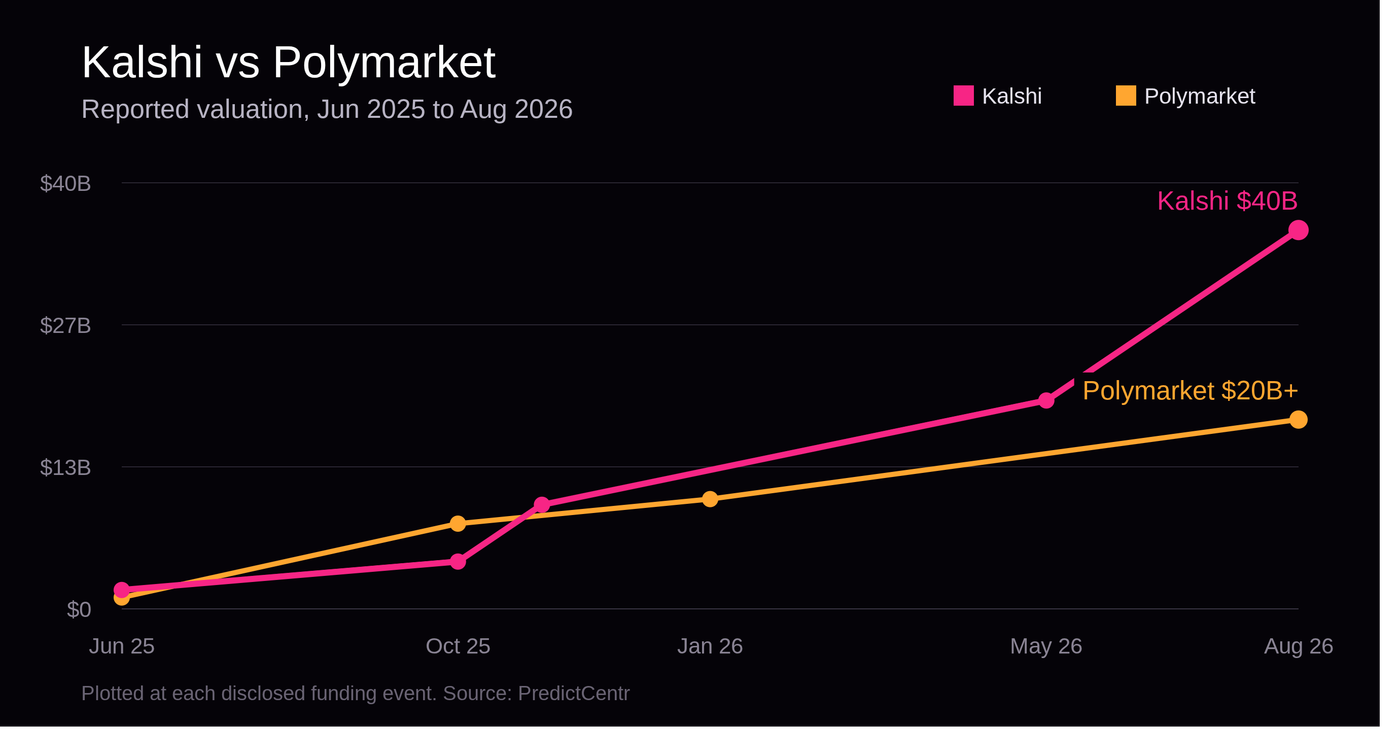
The second was the numbers. In May, Kalshi raised at a $22bn valuation, which is more than Flutter, the largest online gambling company in the world, is worth on the public market. That valuation had doubled in five months. Coatue led it, with Sequoia, a16z and Paradigm in the round. ICE, the owner of the New York Stock Exchange, has committed close to $2bn to Polymarket. How crazy is that?
Then the media gap was very clear. Almost all content in iGaming is heavy. Regulatory analysis and thought leadership written for a few thousand people. In prediction markets you can publish something like "the market moved overnight from 30% to 80% that the US invades Cuba, here is why," and it is serious news whilst also being something a normal person actually wants to read. That audience is enormous compared to ours, and nobody was serving it with real journalistic standards.
“The industry was being formed and the people forming it had never sat in a room together”
We tested it before we committed. In March we published a 55 page research report called The Great Divide and around 1500 people downloaded it. That told us the appetite was real, so we launched the brand in April and built the summit into it. The industry was being formed and the people forming it had never sat in a room together.
You're expecting around 2,500 people from across the prediction market ecosystem in New York. What do you want NEXTPredict NYC to achieve beyond simply getting the industry into the same room - what would make you walk away from the event thinking, "we really achieved something here"?
The thing I care about is not that 2,500 number. It is who those 2,500 are.
We had a moment internally where somebody said we had missed a ticket target, and I pushed back on that, because it measures the wrong thing. The right measure is who is in the room. If the exchanges, the market makers, the institutional allocators, the regulators and the national press are all in the same building for two days, the ticket count takes care of itself.
So, what would make me walk away happy? Deals, first of all. Not "great conversations," actual business that would not have happened otherwise. At our summit earlier this year we booked 20 meetings each for two companies in about ten minutes using our delegate AI agent, and both told us it was their best exhibition ever. That is the unit of value I look at.
The harder one to measure is how the category gets read afterwards. When we started meeting institutional players in New York, more than one of them opened the meeting by asking whether this is a gambling event or a prediction markets event. If the room in October answers that question for them without us having to argue it, that is the win.
And the summit is really only the starting point. What we are actually building is the 365 day connection layer around it. If people leave New York with relationships that are still producing business in March, then I will say we achieved something.
The summit takes place just two weeks before the US midterm elections, when prediction markets are likely to be receiving enormous mainstream attention. How deliberate was that timing, and how much do you expect the election to shape the conversations happening at the event?
Deliberate, but not for the reason people assume.
We are in New York on those dates because October is when this industry does its business and Convene at Hudson Yards was the right room. The midterms fall two weeks later and I would be lying if I said we did not notice.
“we have gone from a 50 pass media plan to somewhere between 100 and 200 press passes”
Where it was very deliberate is the stage. I told our team early on that a healthy part of the main stage needs to be built around content that CNN, Fox, CNBC and Bloomberg will actually send a crew for. B2B panel content does not move a national desk. "A professional Kalshi trader says the polls have got the midterms wrong" does. We designed for that, and we have gone from a 50 pass media plan to somewhere between 100 and 200 press passes.
That said, I would not oversell the election as the theme. Look at the agenda and most of it is market structure. Where capital is flowing across the stack, who makes the market, settlement and stablecoins, RFQs, the latency race, whether event contracts can become a new form of insurance. Here is the dichotomy. The story that gets us on air is not the story our delegates are paying to be in the room for, and both have to be true at the same time.
The wider point is that the two weeks before the vote is when this industry gets judged in public. If the markets read the midterms better than the polls do, the category takes a big step forward. If they get it badly wrong, that is a story as well. Either way everyone will be watching, and we would rather that happens with the industry in one room than scattered across twenty press releases.
You've spent years around the gambling and iGaming industries through NEXT.io. When you look at prediction markets today, do they feel to you like an extension of gambling, a new financial product, or the beginning of an entirely different category?
Its own category, and I say that as somebody whose reference point should push me the other way.
People in iGaming look at prediction markets and see an alternative to sports betting, because that is the only lens we have. The exchanges themselves do not see it that way at all. They see themselves as closer to Robinhood. The audience they are addressing is far wider than the gambling audience and includes a lot of people who would never describe themselves as a gambler but are perfectly comfortable describing themselves as a trader.
I am not going to pretend the philosophical line is always clean. Plenty of things in life carry an element of chance, and most retail traders lose money on the stock market too. You can argue that in circles forever.
What convinced me is structural. It is federally regulated, contract by contract, rather than state by state, so there is no state licensing wall. ICE has put close to $2bn into Polymarket and is selling its market data as an institutional feed. Kalshi has deployed Nasdaq's market surveillance technology. Those are not gambling industry decisions, they are market infrastructure decisions.
“We took a $12,000 position on Kalshi that pays $3m if more than half of JFK's flights are cancelled”
We also used the product ourselves. We took a $12,000 position on Kalshi that pays $3m if more than half of JFK's flights are cancelled on 21 October, the day before our summit opens. That is not speculation. It is us hedging our own operational risk on a single event contract, the same way an airline hedges fuel or a farmer hedges a crop yield. Once you have used it that way, the category question answers itself.
One thing worth adding, because it gets missed. Europe and the US do not agree on this at all. European regulators have mostly treated these products as unlicensed gambling. Nine of them put out a joint statement in June and Spain blocked both Kalshi and Polymarket in May. At the same time ESMA has opened a route under MiFID II for event contracts that qualify as financial instruments. So Europe is split down the middle and there is still not a single licensed prediction market operating on the continent. The trading argument is a distinctly American argument and it works there because the US has a native retail trading culture that Europe never built.
The legal battle in the US increasingly seems to come down to who gets to regulate prediction markets: the CFTC at federal level or individual states through their gambling laws. From speaking to operators, regulators and investors, where do you think that battle is ultimately heading?
I am not a lawyer, so take this as the view of somebody who spends his days in rooms with the exchanges, the funds and the regulators, rather than as a legal opinion.
Right now it is genuinely unresolved, and anyone telling you otherwise is selling something. The Third Circuit affirmed Kalshi's injunction in April and found that CFTC jurisdiction is likely to be exclusive, though that was at the preliminary stage rather than a final holding. District courts have gone the other way in Ohio and in the Southern District of New York. In the first week of August a judge denied the CFTC a restraining order in New York, and a day later a Utah federal court granted the state summary judgment. The Sixth Circuit heard the Ohio and Tennessee cases at the end of July and that opinion, when it lands, will be the first federal appellate ruling of this cycle. The CFTC has now sued at least ten states.

My honest read is that this does not get settled in a courtroom, at least not first. A circuit split of this size ends up at the Supreme Court, and that takes years the industry does not have. The more likely resolution is political. The CFTC's new Innovation Advisory Committee met for the first time on 20 August with prediction markets on the agenda, and the day before that there were exchange executives sitting in the White House. That is a level of engagement I have not seen on any other topic in my career.
I would also say the capital has already voted. Nobody commits billions to infrastructure for a product they believe will be illegal in eighteen months.
Where I think it lands is federal jurisdiction, with the states getting something real in return. Consumer protection standards, age limits, and most likely some tax mechanism. The states are not fighting purely on principle. They built a revenue base on state licensed sports betting and this product does not pay into it. Solve the money question and a lot of the constitutional passion cools down.
Sports appears to be one of the major fault lines in that regulatory fight. Do you think sports event contracts will ultimately coexist with traditional sportsbooks in the US, or are we heading towards a much more fundamental collision between the two industries?
As products they will coexist without much drama. As businesses the collision is already happening, it is just happening inside the same companies rather than between them. DraftKings has launched DraftKings Predictions and then its own exchange on top of it. FanDuel went in with CME back in December, and even that one is reportedly under strain now, which tells you how fast the ground is moving. Fliff and Onyx Markets have both filed to become futures commission merchants. Genius Sports signed Polymarket and Kalshi on consecutive days in August and the stock rose 14% on the first announcement and another 4% on the second. When your suppliers start selling to both sides in the same week, that is a category forming rather than a war.
“you have a structurally cheaper product with a much bigger addressable map”
The reason it still feels like a collision is economics, not philosophy. An event contract on a CFTC registered exchange is 18 plus, it is available in California and Texas where sports betting is not legal at all, and it does not carry anything close to the roughly 50% tax rate a sportsbook pays in New York. So you have a structurally cheaper product with a much bigger addressable map, competing against a product carrying a state licence, a state tax and a heavy marketing compliance burden. No sportsbook can look at that and feel relaxed.
What I do not believe is that sports is the end state. Sports is the wedge. It has the existing audience and the existing habit, so it funds the build. But the sessions our delegates are most interested in are not sports at all. They are hedging, macro signals, corporate earnings, insurance. MEMX has filed with the SEC to list contracts on company earnings, which is a securities route into all of this rather than a CFTC one. That is where the size is, and in ten years I think sports will look small in the rear view mirror.
One of the most interesting things about prediction markets is how quickly major financial, crypto and betting companies have entered or begun exploring the sector. Do you expect the market ultimately to be dominated by a handful of huge platforms, or is there room for a much broader ecosystem of specialist and independent exchanges?
Both again, but at different layers, and I think the two get conflated.
At the venue layer, liquidity concentrates. It always has. That is not a prediction markets thing, it is an exchange thing, and it is why the world ended up with a small number of stock exchanges and a small number of futures exchanges rather than hundreds. Traders go where the depth is and depth attracts more depth. Kalshi and Polymarket are around 90% of the volume today, with Kalshi taking roughly 60% of the Q2 notional on its own. I do not expect that to break into 20 equal players.
But look at the direction of travel. That 90% was about 97% last year. The edge is already leaking, and it is leaking towards Limitless, Crypto.com, Opinion and a long tail nobody was writing about twelve months ago.
And the venues are not the industry. Ask a different question. Not "how many stock exchanges are there," but "how many companies make money from equities trading." Then the answer is thousands.
“A large share of the companies coming to New York in October are not exchanges at all”
That is what is being built right now. Distribution is going everywhere. Robinhood, Interactive Brokers, Webull, Coinbase, Crypto.com, Gemini, Alpaca, and Apex reaching 40 million plus accounts. Market making is Susquehanna, Jane Street, DRW, Jump. Then the whole layer underneath, data, settlement, surveillance, compliance, resolution integrity. A large share of the companies coming to New York in October are not exchanges at all.
There will also be specialists. Verticals where a general venue is not the right home. Corporate earnings, weather and climate, scientific and pharmaceutical outcomes, internal decision markets. Different customers, different rules, different products.
So my answer is a concentrated core and a very wide edge. The mistake would be to look at the top of the table today and conclude the opportunity is closed.
There are also increasingly difficult questions around market integrity, insider information, manipulation and even whether certain markets should exist at all. Where do you personally think the industry needs to draw the line?
This is the question I care most about, and I would much rather the industry answer it before somebody answers it for us.
My personal line is where the contract creates a reason for a human being to make the outcome happen. A market on whether a named individual gets hurt, on a specific referee decision, on an assassination or a terror attack. Those are not information problems, they are incentive problems. The CFTC has proposed banning several of them and I think they are right. The industry should have got there first.
“Kalshi has Nasdaq running its market surveillance and has made geolocation checks mandatory for programmatic users”
Insider information is the more interesting one, because finance has spent a hundred years building the machinery for it and this industry has had about two. But it is being built now and it is being built fast. Kalshi has Nasdaq running its market surveillance and has made geolocation checks mandatory for programmatic users. Chainalysis is in the space. That is the right direction, and it is one of the stronger arguments that this is market infrastructure rather than entertainment.
The one that keeps me up is the audience. We took a decision that our summit would have no student ticket tier and that the word student would not appear anywhere in our collateral, because the industry is under scrutiny for how it markets to younger people and I did not want us anywhere near that. We kept a discounted tier for early stage companies at $899 and called it what it is. A very small thing, but you set your line in small things.
I apply the same rule to myself. I turned down a media outlet earlier this year with real reach because they rank on keywords that target self excluded players. The reach was not worth it.
And the honest answer to whether certain markets should exist at all is that some should not, and the industry will only find those edges by having the argument in public. That is a large part of why we put compliance officers on the stage rather than tucking them away in a side room. They are the ones who actually have to make these calls on a Monday morning.
Finally, if we meet again at NEXTPredict NYC five years from now, what do you think will have changed most dramatically about the prediction market industry?
A few things, and the one I find most interesting is the one nobody is talking about yet.
The obvious change is that "prediction markets" stops being the name. It becomes event contracts, and it becomes a line in a portfolio rather than a category. You will not open a prediction markets app any more than you open an options app. It will simply be there, inside whatever brokerage you already use.
The second is that hedging becomes bigger than speculation. Today the volume is dominated by people taking a view. In five years I think the bulk of the notional is businesses and funds hedging real exposure. Weather, supply chains, elections, regulatory outcomes. It starts to look like insurance for risks that were never insurable, and that market is enormous compared to the one we have now.
“ICE is already distributing Polymarket data as an institutional feed”
The third is that the price becomes the product. ICE is already distributing Polymarket data as an institutional feed. Give it five years and the market probability gets read out on air next to the index, and journalists quote it the way they quote a bond yield. That is the moment the category stops having to explain itself.
But the change that would be genuinely dramatic sits one step further out, and that is decision markets. Companies and governments running internal markets to decide things rather than to trade on them. Should we ship this product, will this project run late, will this policy hit its target. Robin Hanson has been writing about this since the 1990s and it has always been a thought experiment. It stops being a thought experiment the moment the infrastructure is cheap and the legal position is settled. That is the version of this industry that changes something outside of finance, and I think we are closer to it than most people realise.