

It's fair to say that in the fast-paced ever-changing gambling landscape of the US, prediction markets have ruffled a few feathers. The two major players, Kalshi and Polymarket, have captured roughly 97% of the total event-contract market in the country, and they are about to attempt to raise another $1bn each.
Despite that success, both companies are in a legal fight for survival. This isn't just one lawsuit, it's a separate battle waged across multiple states, and those conflicts have seen mixed results so far. Kalshi's wins include a Third Circuit Court of Appeals ruling in New Jersey and injunctions in Nevada, while some of its major defeats include state-governed bans in Massachusetts and Ohio.
The situation has escalated to such an extent that the federal government has sued states directly, including Arizona, Connecticut, and Illinois, arguing that they infringed on exclusive federal jurisdiction by attempting to ban prediction markets. And states have fought back as well, with New York seeking a reported $36bn in penalties from Kalshi, claiming it runs an "illegal gambling operation."
PredictCentr recently caught up with SCCG Management Founder and CEO Stephen Crystal to get his insight into this legal battle, what the end result might be, and whether prediction markets are worth the money that investors are plying into them. He says that while the shape of the battle might be familiar, "the venue is not."
“A product arrives, asserts that it is not gambling, scales nationally before any regulator has ruled, and then spends three years being litigated and legislated state by state.”
Crystal explains: "In 30+ years as a securities and gaming attorney I have watched this same argument run at least twice. Daily Fantasy Sports (DFS) is the closest parallel. A product arrives, asserts that it is not gambling, scales nationally before any regulator has ruled, and then spends three years being litigated and legislated state by state."
As Crystal establishes, in the case of DFS, no one won. Instead, it ended in a "patchwork of statutes." The operators who were able to survive it were those who had preempted the legislation that would eventually be implemented and built for it early.
Crystal acknowledges that this fight is a little different though. By "venue," he means the forum on which this argument is being had. The discussion regarding prediction markets is not confined to states, instead it is occurring on a federal level. The Commodity Futures Trading Commission currently has oversight over the markets, and the federal government therefore argues Kalshi and Polymarket are not answerable to state gaming regulators.
The SCCG Founder equates this to the Indian Gaming Regulatory Act, which since its enactment in 1988 has seen tribal nations locked in legal battles litigating "where the federal line falls." This has occurred most recently in relation to online sports betting, with a string of tribal nations arguing they should be able to offer statewide online betting as long as the server is located on tribal lands - the Seminole Tribe of Florida being one pertinent example.
“a very different fight from the one the industry is used to having.”
The difference here is the backing of a financial regulator. As Crystal says, this changes "which agency writes the rules, and crucially which court hears the appeal." It is "a very different fight from the one the industry is used to having."
But none of these legal distractions have prevented Kalshi and Polymarket from making hay while the sun shines. Both are reportedly seeking a fresh round of funding at $1bn each. Kalshi closed a funding round for the same amount in May - that time the company was valued at $22bn - this time around it's valued at $40bn. Polymarket's latest valuation is a slightly more-modest $20bn+. Importantly, these figures are based on press reports about private funding rounds, not official SEC filings.
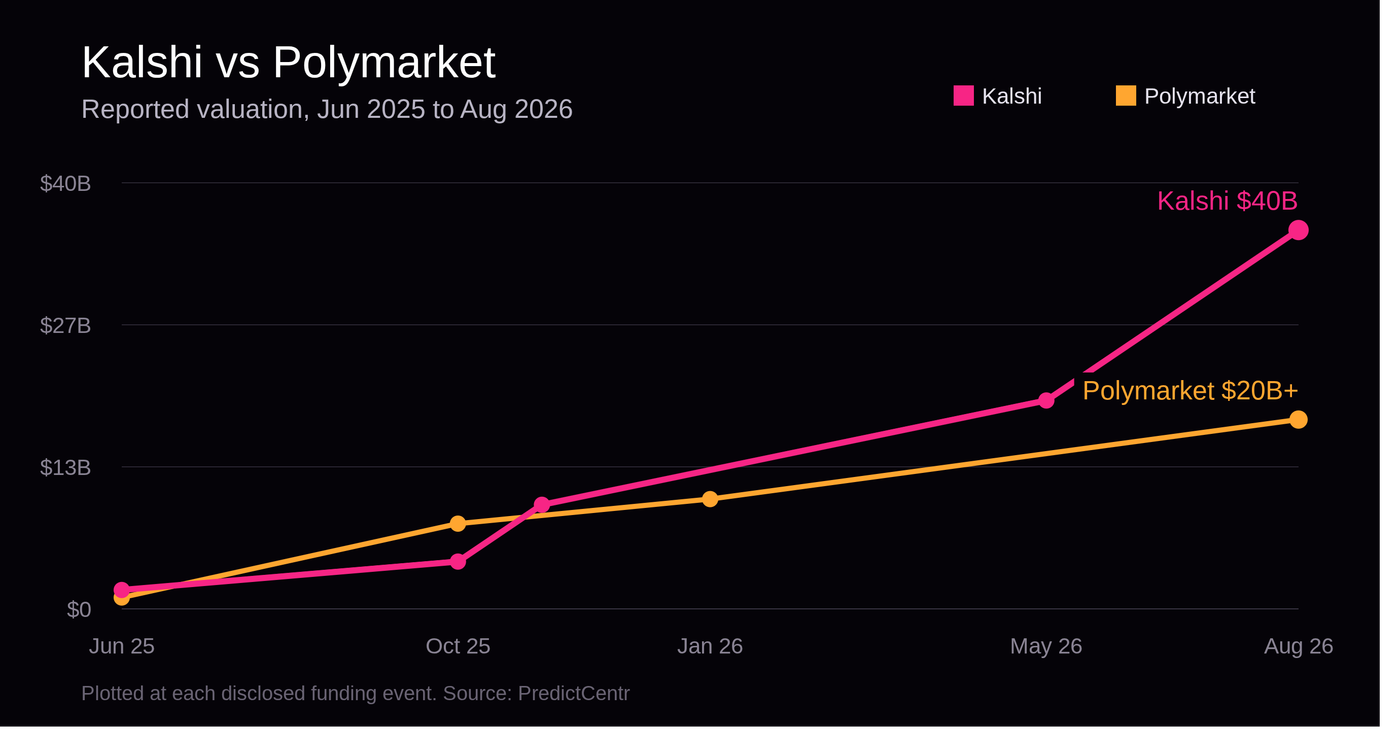
Asked whether these valuations are justified, Crystal says "not on current value." Prediction markets earn their revenue by charging a small fee on each exchange, meaning they need a large volume of exchanges to occur. "You cannot get to $40bn on fees from $31bn of monthly notional volume on any multiple I would sign my name to," the gaming expert asserts.
Instead, Crystal believes prediction markets are betting on a regulatory outcome. In the best case scenario, Kalshi and Polymarket have access to the entire US sports betting market plus everything sportsbooks cannot legally offer. But in the opposite scenario, prediction markets become what Crystal calls "an ordinary sportsbook with an unusually good technology stack," bound by the same rules and regulations as existing sportsbooks.
“a federally regulated financial product carrying consumer protections borrowed almost wholesale from gambling.”
Ultimately, the SCCG Founder believes prediction markets will end up "a federally regulated financial product carrying consumer protections borrowed almost wholesale from gambling." If Crystal is correct, they will eventually introduce age verification, self-exclusion, and other checks and balances, because of political pressure to apply them.
However, Crystal is quick to caution that they will likely not land anywhere permanently. "We are still litigating the borders of statutes written in the 1980s," he says. "The likeliest outcome is not a clean settlement but a durable, untidy equilibrium - federal designation for the exchanges, state-level consumer rules layered on top, and a decade of argument about the seams."